Gosh I’ve missed writing! Why have I left it for so long? Well the good thing is I’ve been triggered!
I’ve been observing changing behaviours lately and the impact it has on disruption of industries and businesses. This was triggered by a picture shared in our Harvard Business School cohorts WhatsApp group last week. It was a simple PowerPoint slide, with a line down the middle, creating two columns. The left column showing what people are spending more on, then the right column showing what people are spending less on as a result. There is no time frame given, but this simple contradistinction was mind blowing for me (clearly doesn’t take much).
Now when you look at this picture (courtesy of The Demographics Group) I challenge you to use one hand to cover either the left or right hand column.. and then guess the alternative product that rises or falls in the opposite column; or better yet, get someone else to attempt a guess. After all, what would 2019 be without a #challenge? (All my YouTubers, YouTubeMums and YouTubeKids, know what I mean – the rest of you please take a moment to update yourself via this link).
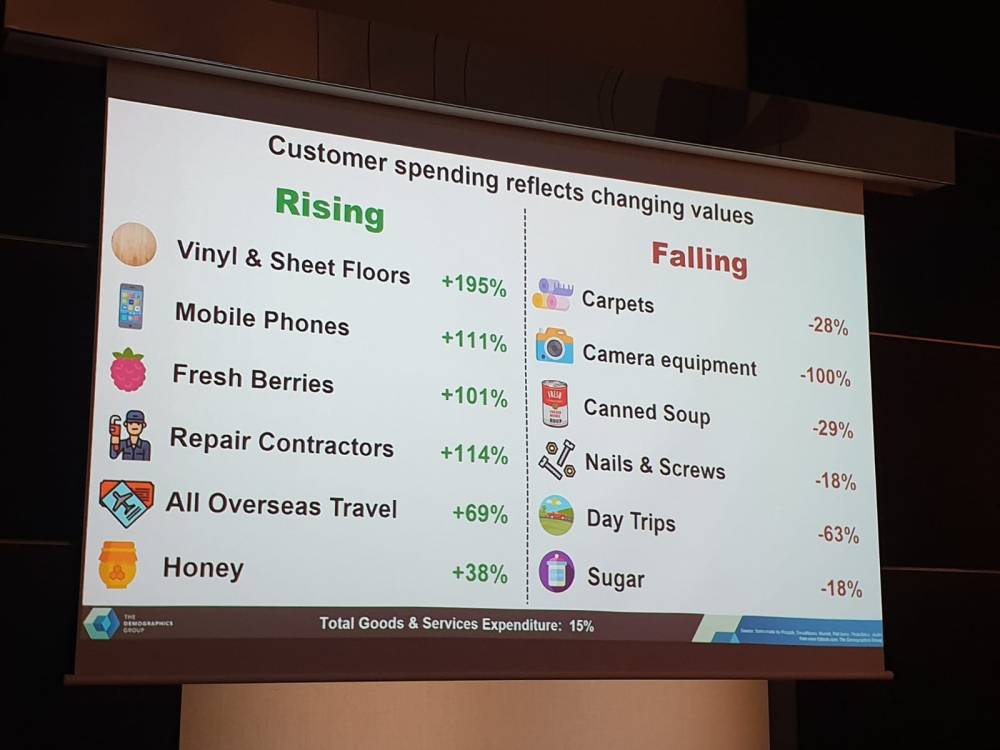
The title of the slide says it all, keyword for me is changing values. In the CX, Digital and marketing business world, we tend to talk a lot about consumer behaviour and no one has really yet defined what causes waves in behaviours over time. Traditionally, it’s put down to the ‘changing technological landscape’ – so cringe. However, this paints a different picture. I’ve always maintained that tech is simply an enabler not the initiator for any movement. We should start to appreciate that the things consumers value are those things that anchor their emotional or spiritual grounding. Value can be classified as something an individual feels has an effect on his or her wellbeing – be it an object, a condition or an activity, it must serve to be positively important to the individual.
Studies on human behaviour and the concept of value, teaches it’s an ego centric outcome, one that is about doing what is right for you and you wellbeing. However, I’m now observing the blending of socio-centric behaviours vs. ego-centric behaviours, where doing what is right for you (ego centric) is benefiting the rest of society (socio-centric) e.g. eating less meat. In the same way, the reverse can hold true – more overseas travelling, though beneficial for an individuals cultural awareness and spiritual well-being, may not be so great for the environment.
Now, looking back at the list above, it tells me a few things that consumers are valuing more:
- Time: Pay someone with the expertise to do the job, rather than spend your free time in DIY mode. If you’re in my family, this includes eventually spending money to get repairs done and the original job done professionally.
- Health: We are living longer, and a lot of us want to spend that longevity enjoying life not making weekly visits to the hospital, or being a burden on the younger generation. Gym memberships have soared, pay as you go membership is now a do or die payment strategy. Nowadays more consumers consider total well being and care for the environment to be top priorities. We are rightly becoming more concerned about our external surroundings and our physical and mental health. As a result, this hyped awareness is encouraging consumers to favour brands that promote health and protection for the environment and sustainability of the one Earth we have. For example a growing number of fast food restaurants have stopped using plastic straws due to the growing issues being caused to our World’s oceans from plastic waste.
- Experiences: The rise of the hashtags #YOLO #FOMO #IRL becoming part of the common vernacular of the average British grandmother says it all.
What does this mean for disruption?
We often use disruption in the business world as a relative term and broad in its coverage. Too frequently, it’s used loosely to describe an innovative concept, a change in strategy, or any situation in which an industry is shaken up and incumbents who were previously leading the industry stumble. However, a new product or business model is disruptive only relative to an existing product or business model. According to Clayton M Christensen, the Harvard Business School professor who first coined the term disruption in the 90’s, defines disruptive innovation as:
“…an innovation that creates a new market and value network and eventually disrupts an existing market and value network, displacing established market-leading firms, products, and alliances.”
Disruption in this sense, is not only about the product or service in itself, but the performance of the product or service, the target customers and the business and financial operating model it chooses to pursue. To answer the question what does this mean for disruption, we need to look at where consumers and even non consumers are doing instead relative to existing market leaders in an industry. To look for where disruption is coming from, start to look more closely at changing behaviours that are linked to values. This can be successfully achieved by helping organisations to ask questions like:
- What does this mean for consumers in our industry, both those that are currently under-served in some markets or are non consumers today?
- Is the performance of the products or services that are on the rise because they are now more accessible, simpler or convenient?
- What business models are the new and existing market players utilising? E.g. are they utilising a financial strategy that will either earn attractive returns at discounted prices to win at lower ends of the market or, in its bid to target consumers who either lacked knowledge or money previously, are they making money at lower prices since gross margin per unit sold will be lower?
- Consumers that are leaving us – where are they going instead and why? What is that organisation doing differently and what values does it share with our lost consumer base?
Once these questions have been asked and analysed, I wager a bet equal to the longest Love Island 2019 relationship, that consumer’s values around time, health and experience will have a role to play in the answers.
Conclusion
The organisations who are in tune with the flexing value systems of today’s consumers are the ones who will be on the winning streak of disruptive change in the years to come. To achieve their business goals, businesses need to have a deep understanding of consumer behaviour, which is linked to what consumers value. Nowadays, the focus is on the integration of technology but at the same time we need to maintain the balance between the digital and human psyche. The key is to make adjustments according to what your customers want. The best way to do that is by letting them guide your decisions and researching the market to make sure your products, your business model, your company values and how you perform are not in opposition to what matters most to them.

 Stay Experiencing