
Artificial intelligence (AI) is the ability of a machine or computer program to think and learn. It’s all about building machines that could be capable of thinking, making decisions based on logic and then learning over time – not dissimilar to how you or I start out in life!
I’m amazed at the progress that has been made with AI over the last few years, most notably in the ways it’s improving customer experiences digitally. When you say AI, the image of robots live in action still pops up in peoples minds. However, the advances in AI mean you are more likely to be using it in your everyday interactions without realising it. There’s more and more emerging developments from the field of AI, and Artificial Intelligence is one of the hottest tech at this moment in time. According to IDC, spend on Artificial Intelligence will double in the next four years, reaching £90 billion by 2024. The IDC states that “AI is the game changer in a highly competitive environment, especially across customer-facing industries such as retail and finance, where AI has the power to push customer experience to the next level with virtual assistants, product recommendations, or visual searches.”
Here are three of my favourites everyday examples that shows just how AI is transforming customer experience
- Improving Personalisation: Personalised content is everywhere – from your social media, to the ads you see and the programmes you watch. Data is King and is very valuable currency. In order to use it effectively however, the data needs to be harvested from good and reliable data sources. Artificial Intelligence is then layered on top of this to create learning algorithms that processes that data. The combination of AI and machine learning for gathering and analysing social, historical and behavioural data means companies are able to gain a much more accurate understanding of us — their customers. Unlike traditional data analytics, AI is continuously learning from the data it analyses, and is able to anticipate customer behaviour as a result. This allows brands to provide highly relevant content, increased sales opportunities and improve the customer journey. It’s what allows recommendations to be made when you watch YouTube and Netflix; It’s what allows recommendations to be made about the music that is suggested next on Spotify or Apple Music; It’s what allows recommended products on Amazon to show up or recommended accounts to follow on Instagram – the AI algorithm knows who you’ve been social media stalking that’s why their friends profile is suggested as someone to follow. Any and all content related to the things you like and are likely to consume or buy is brought to the forefront and we see that over time. Personalisation of both content and recommendations will continue to improve and today it is delivering competitive advantage for leading brands like Netflix and Amazon.
- Improving Customer Service: Still a long way to go, but the days of being put on hold for minutes on end are disappearing (I hope!). I’m not talking voice recognition here — there’s still a long way to go there, especially with HMRC, as no matter what I say, the only response I get is “Press 1 to make additional payments….” I digress…. AI is changing the game for customer services by introducing the use of chatbots and virtual assistants to answer the most common service related questions. This is being used widely in Banking where one of the best experiences I’ve been fortunate to get a demo of, is Natwest’s chatbot Cora. Cora is quite slick and if Cora’s knowledge repertoire doesn’t quite extend to your issue, you’ll be routed to an agent in the right department who can continue the conversation on the same chat with all of the context from your chat with Cora, so you don’t need to retype it all again. Take a look at the example below for reporting a card lost or stolen. There was no wait time, no need for 1101 questions on where you were when you lost your card. Just a simple, straight forward (and compassionate I must add) response based on the options I selected from Cora’s possible answers. The issue is resolved then and there with no further human interaction required.

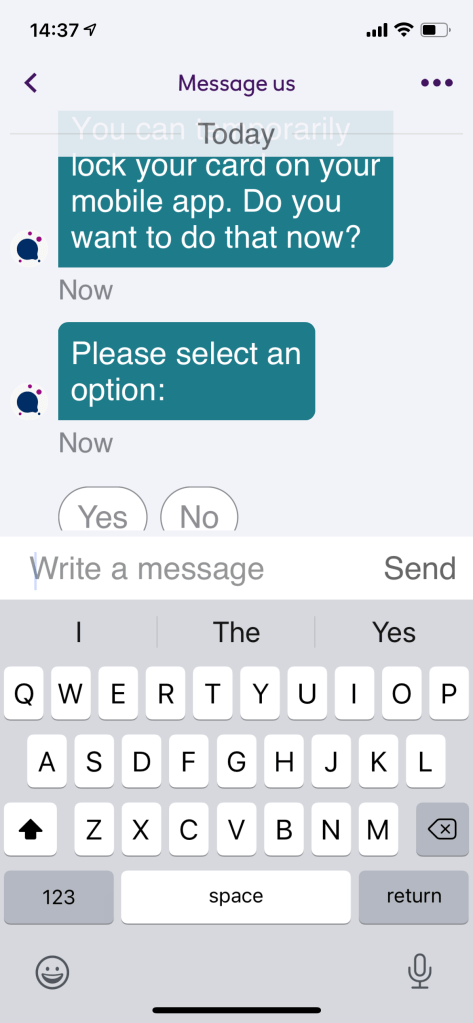

Chatbots are not all singing all dancing innovations just yet, and sure there are more complex problems that even Cora just would not be suitable for. For example an advised sale of a mortgage or insurance product. However, chatbots are doing a lot to improve customer service by providing simple solutions to problems hundreds of customers call about every day. This is not only freeing up customer service calls for more complex issues, but is also freeing up time for customers to get on with living and experiencing, whilst all providing the needed learning opportunity for the AI algorithm to improve each day.
3. Automating from your home: The days of shouting for someone to turn the heating on while you are lounging in bed watching the recommended list on Netflix are nearly behind us, all because robotic AI is becoming commonplace in our homes. Yes, Alexa can turn on music and dim the lights, but companies in the retail and banking industries are also using Alexa and Google home to allow customers to carry out common tasks. Banks are leading on voice discovery and ideation by piloting concepts such as allowing customers to carry out voice initiated transfers and bill payments across Alexa, Google Assistant and Siri platforms. Since using voice assistance technology is more simple, intuitive and quicker than typing a request, it’s easy to see why it’s about to become more common place to use AI in this way in our homes. Whether it’s to make payments, organise finances, or even seek tips on how to save money without even getting out your smartphone. This is another way AI is transforming the customer experience and I look forward to seeing this particular transformation grow.
Watch out – AI comes with issues too
So there you have it, three of my top examples of how AI is being used to transform everyday experiences to make them simpler, faster, easier and more relevant. AI is helping brands connect with customers on a more personal level by using the technology to gain understanding of who customers are, how they feel, and what they are likely to do. However getting AI wrong is too easy. Two of the best ways to make sure AI is supporting and enhancing customer experiences rather than diminishing it are:
- Data Diversity: There are many high profile examples of where lack of diversity in the data sources being used by the learning algorithms have led to questionable decisions. Amazon’s internal recruiting application downgraded female candidates, Microsoft’s AI chatbot adopted anti-Semitic speech in response to conversations on Twitter. For these reasons it’s imperative that organisations make sure the algorithms and the results they produce are tested widely and with diversity and variety of their customers in mind. This strongly applies to the data inputs as well as testing the outputs produced so data bias is recognised and removed.
- Draw boundaries: Privacy is a big concern when it comes to the underlying data that is being harvested and used by AI tech. Companies making use of AI need to find balance by creating boundaries between information used to produce positive customer experiences and the need to respect privacy and data risks. Making policies as transparent as possible is one way this can be achieved, but also educating costumers on the options available for controlling how their data is used, is another highly effective way of drawing boundaries.

 Stay Experiencing